
Mindful spending guide
No Spend Challenge: Rules, Tips & How to Track It
A no spend challenge can help you interrupt automatic spending, notice what you buy out of habit, and keep more money for things that matter. The key is making the rules clear enough to follow—and realistic enough to finish.
What is a no spend challenge?
A no spend challenge is a period when you intentionally stop buying things you have decided are non-essential. You still pay for necessities and existing commitments, but discretionary purchases are paused according to rules you set before the challenge begins.
The goal does not have to be spending absolutely nothing. For most people, that would be unrealistic. The useful part is creating a temporary boundary around optional spending so you can notice your habits and make purchases more deliberately.
For example, you might continue paying rent, utilities, groceries, transportation and other essentials while pausing restaurant meals, clothes, entertainment purchases and spontaneous online shopping.
No spend challenge rules
There is no universal rulebook. A challenge works better when you decide what counts before you start rather than negotiating with yourself every time you want something.
Usually allowed
- Housing and utilities
- Groceries and household essentials
- Transportation needed for daily life
- Healthcare and medication
- Insurance, debt payments and existing bills
- Previously committed expenses you choose to honor
Often paused
- Takeout and restaurant meals
- Clothing you do not need
- Impulse online purchases
- Decor and hobby purchases
- Paid entertainment you can skip
- Convenience purchases you can reasonably avoid
Your version can be stricter or more flexible. If coffee with a friend is important to you, for example, you can explicitly allow it. The point is intentional spending—not creating rules that make normal life impossible.
A simple rule to use
Before buying something, ask: Is this essential, already committed, or specifically allowed by my challenge rules? If the answer is no, skip it and record the decision.
7-day, 30-day or no spend month?
A short challenge is easier to start; a longer one gives you more opportunities to see patterns. Choose the timeframe that fits what you are trying to learn.
Good for a first attempt. It is long enough to interrupt routine purchases without feeling overwhelming.
Long enough to encounter weekends, social plans, recurring temptations and different spending situations.
Easy to measure against your normal monthly spending and useful if you want a clean start and finish date.
You do not need to jump straight into a no-spend year. A challenge you complete and learn from is more useful than an extreme one you abandon after a few days.
How to prepare for a no spend challenge
1. Decide why you are doing it
Give the money you are trying not to spend a purpose. Maybe you want to build an emergency fund, pay for a trip, reduce credit-card spending, or simply understand where impulse purchases happen.
2. Write down your exceptions
Define essentials and planned exceptions before day one. Birthdays, necessary replacement purchases or a pre-booked event do not have to derail the challenge if you deliberately include them in your rules.
3. Identify your common triggers
Think about where optional spending usually starts: delivery apps, browsing stores, promotional emails, social media, boredom, convenience or a particular part of your routine. Removing some of those prompts makes the challenge easier. If spontaneous purchases are the main issue, use the strategies in our guide to stopping impulse spending.
4. Decide how you will track progress
You can track successful days, skipped purchases, money not spent, or a combination. Pick a method you will actually maintain.
Track more than a checkmark
See what you chose not to spend
A calendar can tell you that Tuesday was a no-spend day. Unspent can also show you the decisions behind it: the $6 coffee, $25 takeout or $80 impulse purchase you considered and chose to skip.
Log each skip, connect it to a goal, and watch those choices add up over the challenge. Unspent does not connect to your bank—you decide what to record.
Download Unspent on the App Store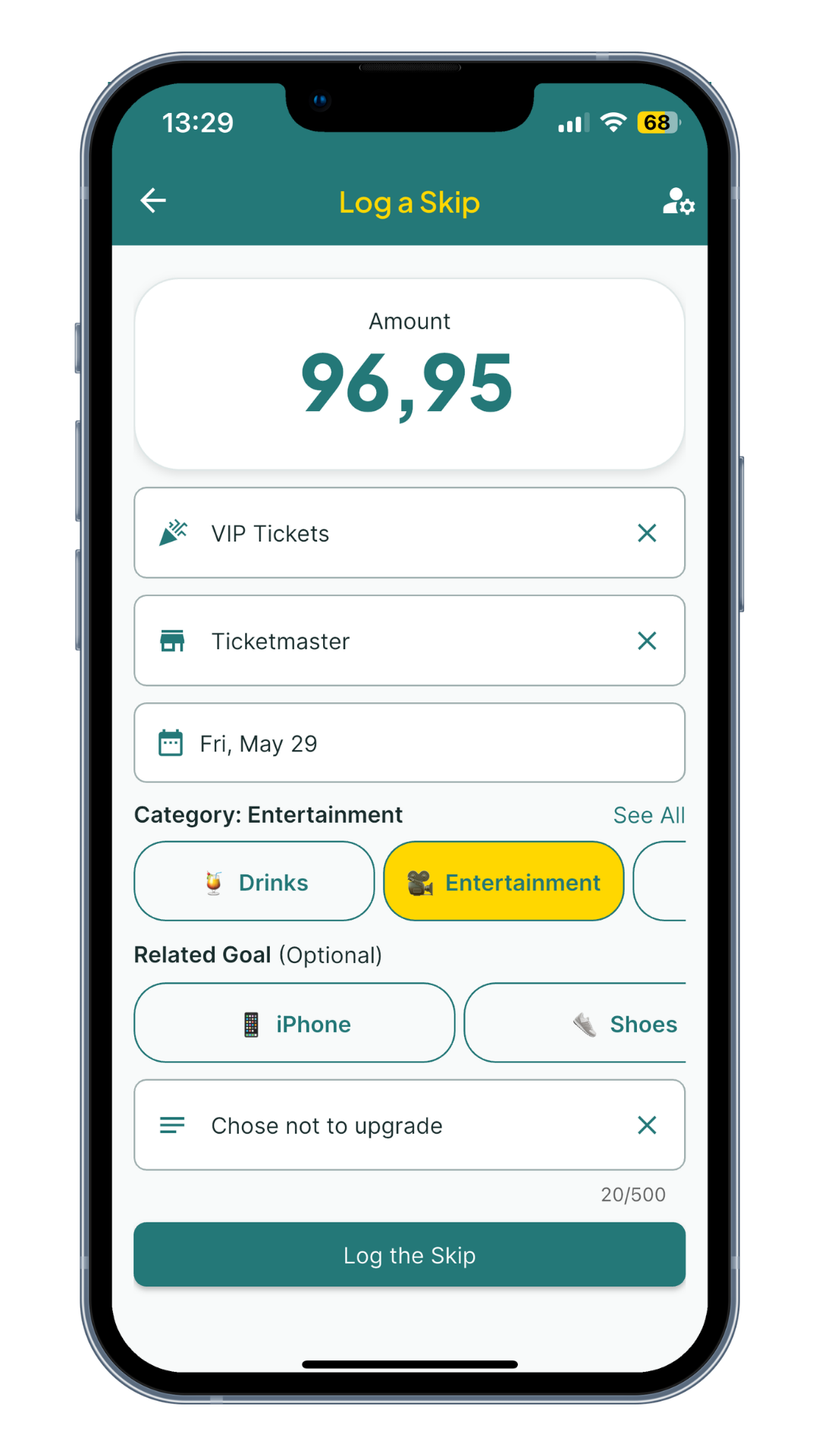
How to track a no spend challenge
There are two useful measurements, and they answer different questions.
No-spend days tell you how consistently you followed your rules. Skipped purchases show the individual decisions you changed and the approximate amount you kept by not making them.
Suppose you avoid a $7 coffee on Monday, decide against $32 of takeout on Wednesday and skip a $65 clothing purchase on Saturday. A calendar might show three successful decisions across the week. Recording the skips also gives you $104 of purchases you consciously chose not to make.
That number is best treated as money not spent, not automatically as savings. If you want it to become actual savings, consider transferring some or all of it to a savings account or assigning it to a specific financial goal.
What to do when you want to buy something
Use a waiting period
For a non-essential purchase, save it and revisit it after 24 or 48 hours. The delay separates the initial urge from the decision.
Make the alternative visible
If you skip something, record the amount or move money toward a goal. Turning “I didn't buy it” into visible progress can make the decision feel less like deprivation.
Replace the activity, not just the purchase
If spending is tied to boredom or routine, simply banning the purchase leaves the trigger in place. Replace browsing shopping sites, ordering food or wandering stores with a specific alternative.
Do not treat one purchase as failure
A purchase outside your rules does not erase the decisions you made before it. Note what happened, adjust if necessary and continue. A challenge is useful when it teaches you something—not only when it produces a perfect streak.
What to do after your no spend challenge
At the end, look beyond the total. Which purchases were easiest to skip? Which ones kept tempting you? Did you miss everything you stopped buying, or only a few things?
Use those answers to decide what should return. You might discover that some purchases are genuinely worth keeping while others were mostly habit. That is where a temporary no-spend month can turn into longer-term mindful spending. If your goal is broader than a challenge, see how to build a realistic spend-less system.
If you tracked skipped purchases, review the categories and amounts. The goal is not necessarily to keep living under challenge rules forever. It is to carry forward the decisions that improved your finances without making your life worse.
No spend challenge FAQ
What is a no spend challenge?
A no spend challenge is a set period when you avoid non-essential purchases while continuing to pay for necessities and commitments you define in advance.
How long should a no spend challenge last?
There is no required length. Seven days is a practical starting point. A 30-day or month-long challenge gives you more time to encounter different spending triggers and identify patterns.
What can I buy during a no spend challenge?
Your rules are personal, but most challenges allow essentials and existing obligations such as housing, utilities, groceries, transportation, healthcare and required bills. Decide your exceptions before you begin.
Does a no spend challenge mean spending zero dollars?
Usually not. The common approach is to continue necessary spending while temporarily pausing discretionary purchases. The exact definition is yours to set.
How do I track a no spend challenge?
You can mark no-spend days, record purchases you chose not to make, or use both. Tracking skipped purchases also shows the dollar value of individual decisions you made during the challenge.
Ready for your first skip?
Make every no-spend decision visible.
Unspent is a no spend tracker built around the purchases you choose not to make. Start free on iOS.
Download on the App Store