
Mindful spending guide
How to Stop Impulse Spending
Impulse buying happens fast. The most effective response is to slow the decision down, reduce the triggers around you, and make choosing not to buy feel like progress rather than deprivation.
What is impulse spending?
Impulse spending is an unplanned purchase made in the moment rather than a purchase you had already decided to make. It can be a small add-on at checkout, takeout because cooking feels inconvenient, or a much larger online purchase triggered by a sale.
Not every spontaneous purchase is a problem. The useful question is whether the purchase repeatedly conflicts with what you actually want to do with your money. If it does, the goal is not to eliminate enjoyment—it is to create enough space to make a choice instead of reacting automatically.
Why impulse buying is so easy
Modern shopping removes friction. Your card is saved, delivery is fast, recommendations are personalized, and promotions create urgency. That means “just use more willpower” is a weak strategy on its own.
Impulse purchases also tend to have recognizable triggers: boredom, stress, a reward after a difficult day, social media, a sale notification, browsing without a purpose, or simply seeing something at the right moment. Your trigger may be emotional, environmental, or both.
For a week, notice what happens immediately before an unplanned purchase. You are looking for a pattern you can change, not a reason to criticize yourself.
1. Put time between the urge and the purchase
A waiting period is one of the simplest ways to stop an impulse purchase from becoming automatic. When you want something non-essential, save it rather than buying it immediately.
Useful for smaller wants that feel urgent in the moment.
Gives an online purchase enough time to lose some novelty.
A stronger rule for expensive items or categories where you tend to overspend.
The exact number matters less than having a rule before the temptation appears. If you still want the item after the waiting period and it fits your priorities, you can make a deliberate decision then.
2. Make impulse purchases slightly harder
You do not need to make shopping impossible. Add just enough friction to interrupt the automatic sequence.
- Remove saved cards from shopping sites and apps.
- Unsubscribe from promotional emails and push notifications that reliably lead to purchases.
- Delete shopping apps you open out of habit.
- Do not browse stores or marketplaces as entertainment.
- Keep items on a wish list instead of in a checkout-ready cart.
A few extra steps give you time to ask whether you actually want the purchase or simply responded to the trigger.
3. Create rules for your problem categories
Broad goals like “spend less” can be hard to use in the moment. A specific rule makes the decision easier. Examples include “takeout only on Friday,” “no clothes for 30 days,” “no online purchase on the same day I discover it,” or “one coffee out per week.”
If one category causes most of your unplanned spending, start there. You do not have to optimize every part of your finances at once.
Reward the decision not to buy
Track the impulse purchases you skip
When you decide against a $6 coffee, $38 online order or $80 pair of shoes, the decision usually disappears. Unspent lets you log that skip and see those choices add up over time.
The amount is best understood as money not spent. It does not automatically become savings, but you can connect skips to a goal or transfer money separately if you want to turn the decision into actual savings.
Download Unspent on the App Store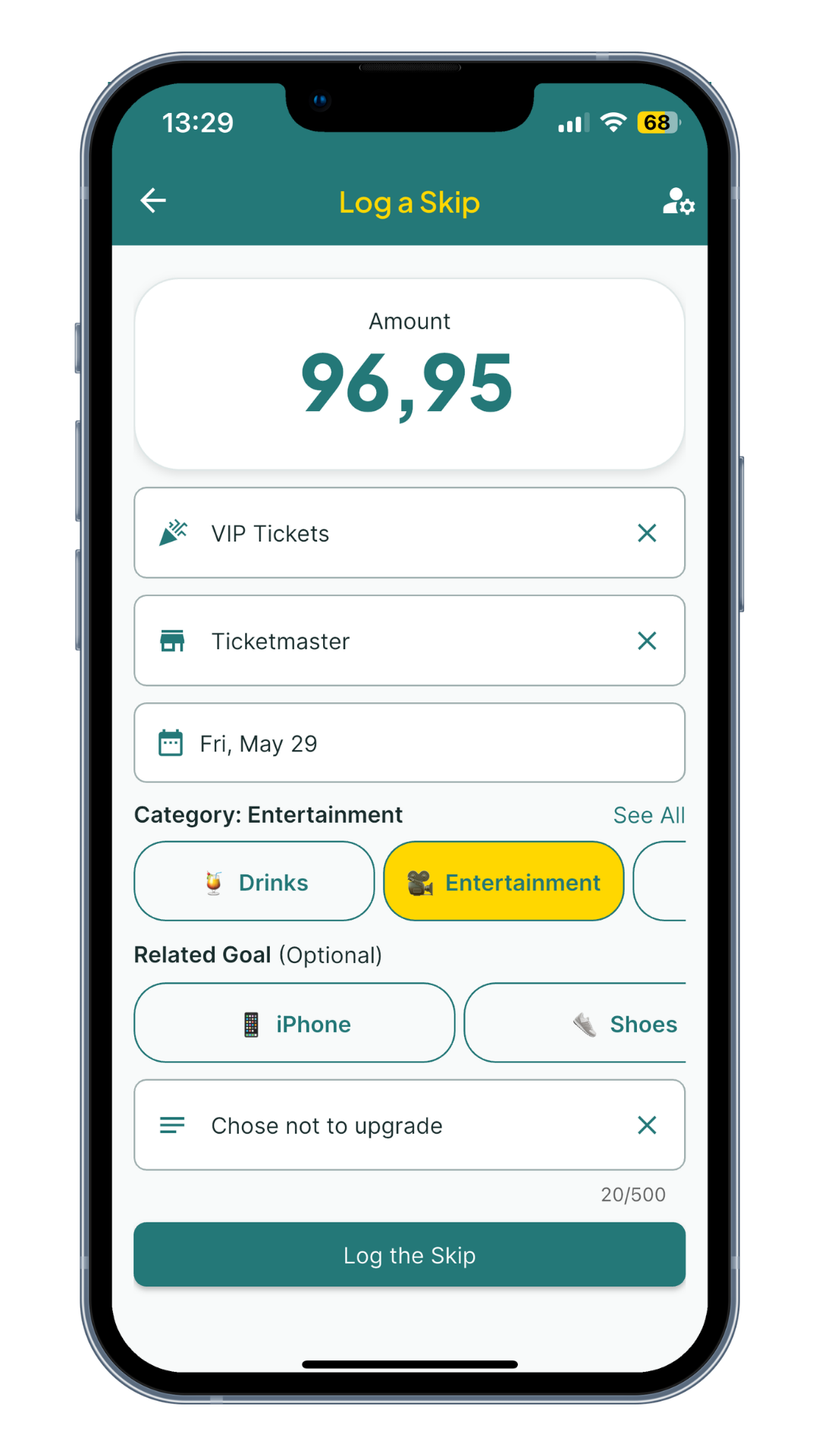
4. Replace the habit behind the spending
If shopping fills a role—entertainment, stress relief, convenience, or reward—removing the purchase without replacing that role leaves the trigger intact. Decide on an alternative in advance.
If you browse when bored, keep a short list of free activities. If takeout is the problem, keep one easy meal available. If buying something feels like a reward, choose another reward that does not undermine the goal you are working toward.
5. Review what you almost bought
A record of skipped purchases can reveal more than a record of expenses. After a few weeks, look for repeated categories, merchants, times of day, and situations. You may find that the same $10–$30 decisions recur much more often than the occasional large purchase.
Then make your next rule specific to the pattern. If online shopping is the recurring trigger, change that environment. If convenience food dominates, prepare for the times when you usually order it.
6. Do not turn one purchase into a spending spiral
An impulse purchase does not require a “start again Monday” response. The useful move is to identify what happened and make the next decision normally. All-or-nothing thinking can turn one purchase into several because the day or week already feels lost.
If you want a more structured reset, a short no spend challenge can create a temporary boundary around discretionary spending while you learn which purchases you actually miss.
A simple plan to start today
Before buying
- Ask whether it was planned.
- Use your waiting-period rule.
- Save it to a wish list.
- Check what goal competes with the purchase.
After skipping
- Record what you did not buy.
- Note the category or trigger if useful.
- Review recurring patterns weekly.
- Transfer money separately when appropriate.
If your bigger goal is reducing spending across several categories, continue with our guide to spending less without making your life unnecessarily restrictive.
Frequently asked questions
What is impulse spending?
Impulse spending is buying something without having planned the purchase in advance, often in response to an immediate urge, emotion, promotion, or convenient shopping trigger.
How can I stop impulse spending?
Create a delay between wanting and buying, reduce exposure to shopping triggers, keep a wish list instead of checking out immediately, and track purchases you decide to skip so progress becomes visible.
What is the 24-hour rule for impulse buying?
The 24-hour rule means waiting at least one day before completing a non-essential purchase. For more expensive items, a longer waiting period such as 48 hours or a week can be more useful.
Why do I keep impulse buying?
Impulse purchases can be encouraged by convenience, emotions, boredom, scarcity messages, social influence, saved payment details, and habits. Identifying the situations that precede your purchases can help you choose a more specific response.
Should I use a budget to control impulse spending?
A budget can help, but it is not the only option. You can also use spending rules, waiting periods, environmental changes, and a record of skipped purchases to make discretionary spending more deliberate.
Make the skip count
Track the purchases you choose not to make.
Unspent turns everyday no-spend decisions into visible progress, without connecting to your bank or requiring a traditional budget.
Download on the App Store